

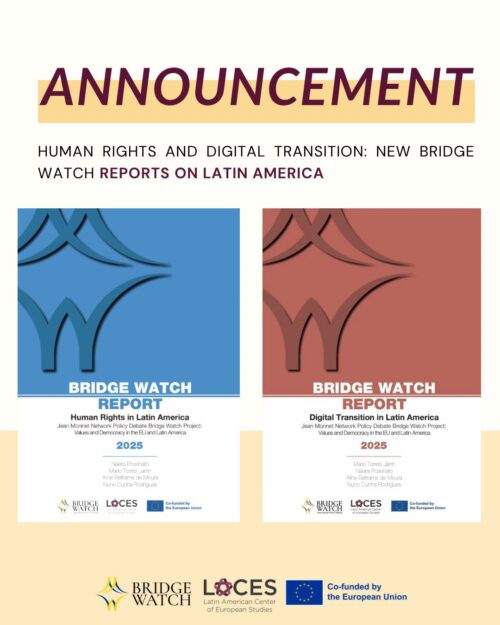
The BRIDGE Watch Project announces the publication of its two annual flagship reports, Human Rights in Latin America and Digital Transition in Latin America, developed within the framework of the Jean Monnet Network Policy Debate BRIDGE Watch – Values and Democracy in the EU and Latin America. These reports are the result of a collective effort involving 52 collaborators and together provide a rigorous, policy-oriented assessment of two strategic areas central to democratic governance and EU–Latin America relations. Altogether, the reports present 171 concrete policy recommendations, offering actionable guidance for public authorities, civil society and academic stakeholders on how to strengthen human rights protection and steer the digital transition in line with democratic values across the region.
The Human Rights in Latin America Report delivers a comparative analysis of institutional frameworks, public policies, and enforcement mechanisms for the protection of fundamental rights in ten Latin American countries. The report identifies both structural challenges and positive developments in areas such as judicial independence, access to justice, compliance with international human rights obligations, and the functioning of democratic institutions. Nevertheless, its conclusions highlight the need to strengthen institutional capacity, accountability, and effective implementation in order to close the gap between legal commitments and lived realities. The report reaffirms that human rights, democracy, and the rule of law are shared values and essential pillars of sustained EU–Latin America cooperation.
The Digital Transition in Latin America Report complements this analysis by examining how digital transformation is reshaping public governance, regulatory frameworks, and social inclusion across the region. Structured around four thematic pillars: digital inclusion and connectivity, green and sustainable digitalization, ethical and transparent artificial intelligence, and cybersecurity. The report assesses national strategies and regulatory approaches in light of European and international standards. Its findings underscore the dual nature of digitalization as both an opportunity for innovation and development and a source of new risks for fundamental rights, privacy, and democratic oversight. The report stresses the importance of people-centered, rights-based digital governance aligned with EU principles, including transparency, accountability, and sustainability.
Taken together, the two reports demonstrate that the protection of human rights and the governance of digital transformation are increasingly interdependent policy domains. Effective democratic governance in the digital age requires robust rule-of-law institutions, while the digital transition must be guided by clear regulatory frameworks that safeguard fundamental rights and public trust. In this context, the reports underline the strategic relevance of enhanced EU–Latin America cooperation, notably through initiatives such as the EU–LAC Digital Alliance, regulatory dialogue, and structured policy exchange.
By providing comparative evidence, policy-relevant analysis, and targeted recommendations, the BRIDGE Watch Reports contribute to informed decision-making and to the strengthening of bi-regional dialogue. They serve as a reference point for policymakers, regulators, academics, and civil society actors committed to advancing democracy, human rights, the rule of law, and sustainable digital governance in Latin America and in EU–Latin America relations.